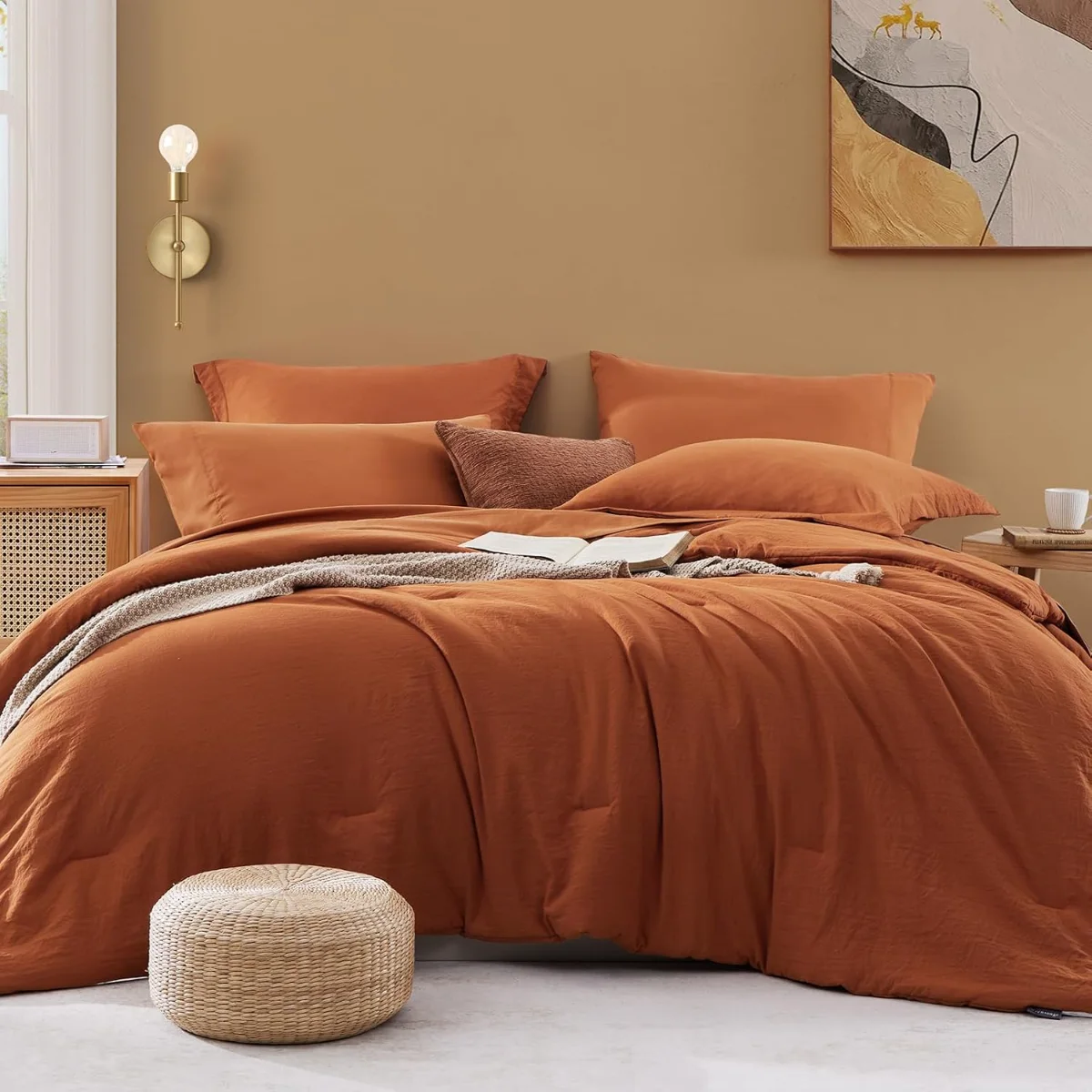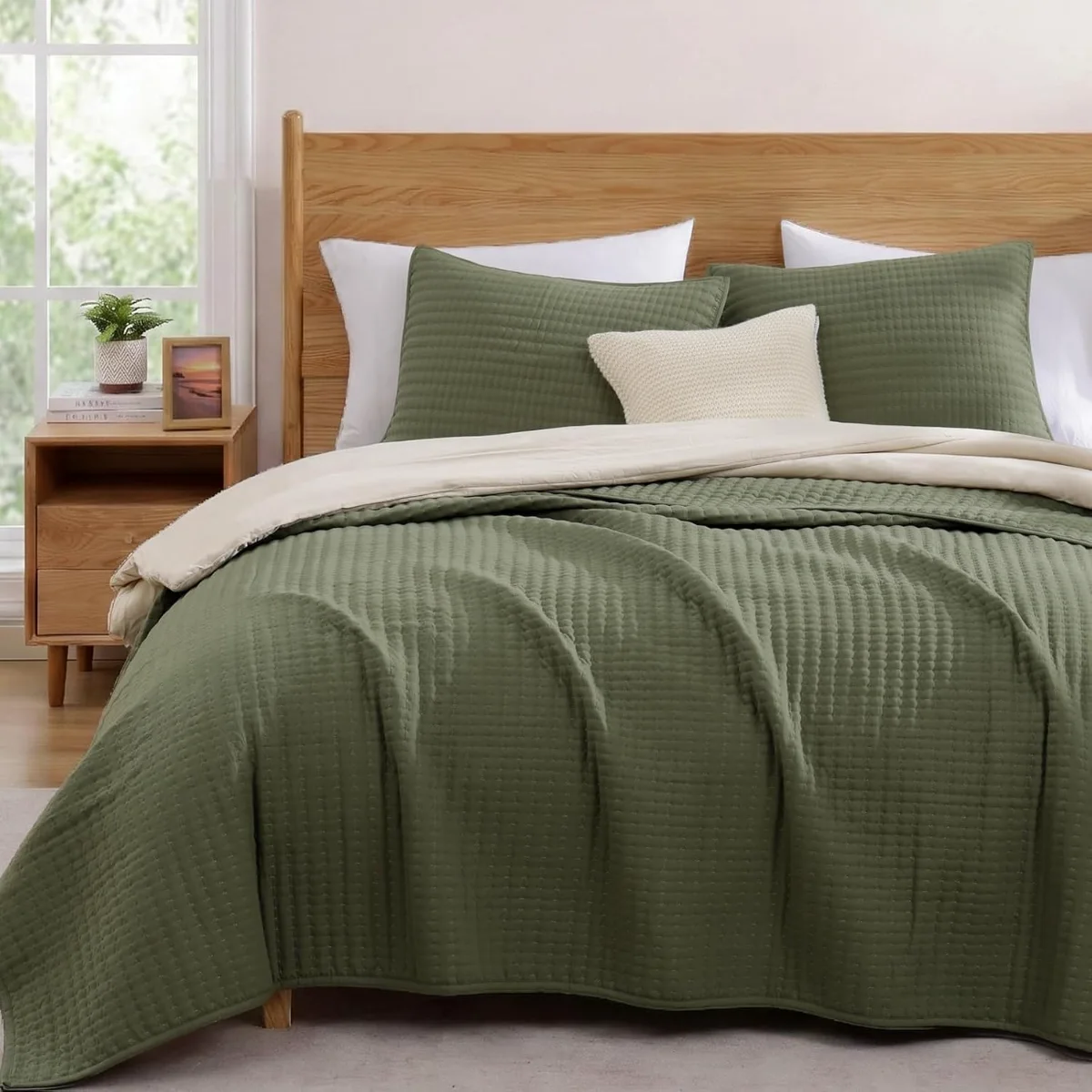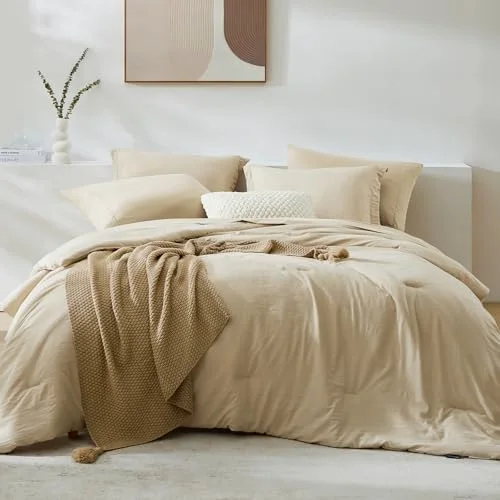
Every bedding aisle in America is organised around five words: twin, full, queen, king, California king. They are useful words. They are also the reason so many beds end up with a comforter that stops six inches short on one side, or a quilt that puddles on the floor and gets stepped on every morning.
The mismatch has a simple cause. A mattress size describes the top surface. A comforter has to cover the top surface and hang down far enough on three sides to look finished and keep a shoulder covered. The taller your mattress, the more of the comforter gets used up on the way down, and mattresses have been getting taller for twenty years.
Start with drop, not with size
Drop is the distance from the top edge of your mattress to wherever you want the bedding to stop. Most people want one of three things:
- To the frame. The comforter covers the mattress and stops just past its bottom edge. Tidy, modern, shows off a bed frame you paid for.
- Past the box spring. The classic look. Hides the foundation entirely.
- Near the floor. A quilt or coverlet look, common in guest rooms and farmhouse bedrooms.
Measure your mattress height with a tape, then decide which of those three you want. That is your drop per side. Now the arithmetic:
| Mattress | Width | Drop 10″ (to frame) | Drop 16″ (past foundation) | Drop 21″ (near floor) |
|---|---|---|---|---|
| Twin | 38″ | 58″ | 70″ | 80″ |
| Full | 54″ | 74″ | 86″ | 96″ |
| Queen | 60″ | 80″ | 92″ | 102″ |
| King | 76″ | 96″ | 108″ | 118″ |
| California King | 72″ | 92″ | 104″ | 114″ |
Hold that against what a comforter actually measures. Every Wrensonge comforter set is cut to the same table, and our 7-Piece Bed in a Bag gives you 90″ × 90″ in Queen and 102″ × 90″ in King. On a standard 60-inch Queen mattress, 90 inches of width leaves 15 inches a side: past the foundation, short of the floor. That is the look most people mean when they say a bed looks made.
On a 76-inch King, our 102-inch comforter leaves 13 inches a side. Still tidy, but if your King sits on a tall platform with a thick mattress, you are into "covers the top, shows the foundation" territory, and you should size up rather than accept it.
The pillow-top problem
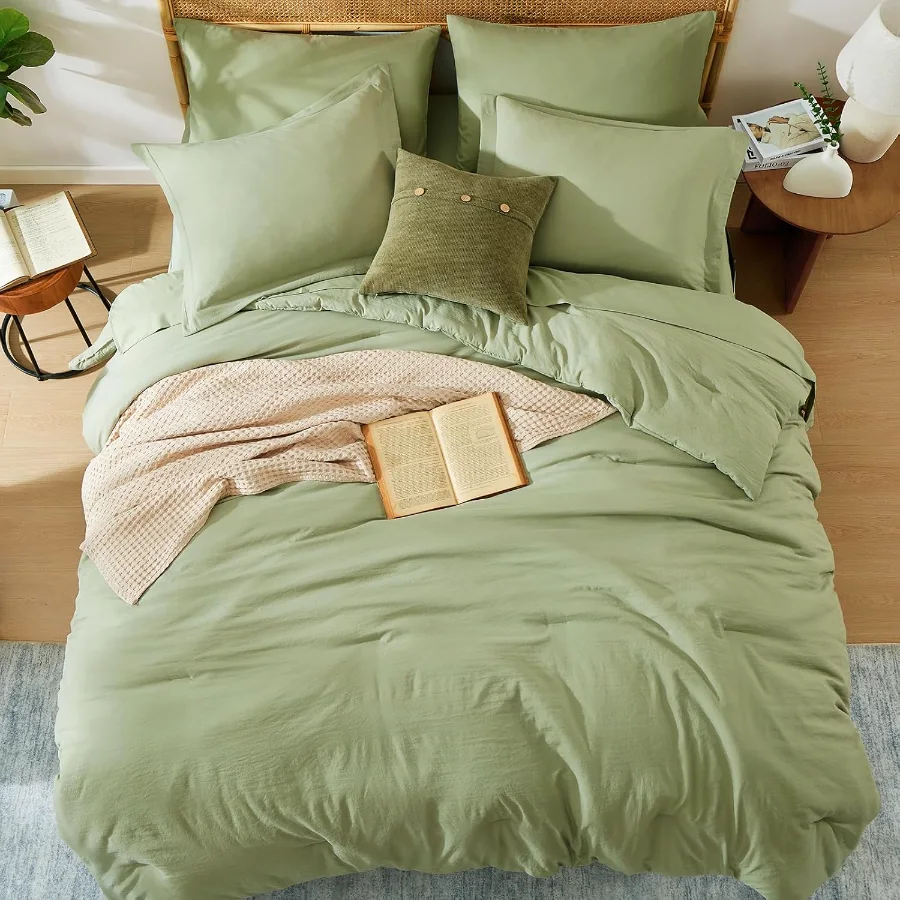
Here is the failure nobody warns you about. Mattress depth has crept from around 9 inches in the 1990s to 12–16 inches today, and pillow-tops and toppers push some beds past 18. Every inch of extra depth eats an inch of drop on both sides.
Take a Queen with a 14-inch mattress and a 3-inch topper: 17 inches of height. A 90-inch comforter still gives 15 inches a side, so it now stops two inches above the bottom of the mattress. The bed reads as unmade no matter how carefully you smooth it.
Two fixes, both honest:
- Buy up a size. A King comforter on a Queen bed is the single most common upgrade in American bedrooms, and it is not a mistake. It is a deliberate 21-inch drop. Our 3-Piece Comforter Set in King gives 102″ × 90″ over a 60-inch Queen: exactly that.
- Buy oversized. Some of our sets run to oversized Queen and Super King cuts for the same reason. One customer chose the oversized Queen specifically because, in her words, "its rare to find an oversized queen".
What does not work is buying a deep-pocket fitted sheet and hoping the comforter follows. The sheet solves the mattress; the comforter is a separate calculation.
The fitted sheet is a different measurement entirely
A fitted sheet has one job: reach around the mattress and stay there. The number that matters is the pocket depth, and ours is 14 inches, printed on the packaging of every set that contains sheets. A 14-inch pocket comfortably fits mattresses up to about 13 inches and will stretch onto a 14. Past that (pillow-top, topper, or one of the very tall hybrid mattresses) you want a deep-pocket sheet sold separately, and there is no shame in mixing.
| Size | Fitted sheet | In which sets | |
|---|---|---|---|
| Twin XL | 39″ × 80″ | 14″ | Twin XL 5-Piece |
| Full | 54″ × 75″ | 14″ | 7-piece |
| Queen | 60″ × 80″ | 14″ | 7-piece |
| King | 78″ × 80″ | 14″ | 7-piece |
Shams, and why yours look wrong
Two sham sizes cover almost every American bed: 20″ × 26″ for standard and Queen pillows, 20″ × 36″ for King. Our sets follow that split exactly: the Queen sets ship 20 × 26, the King sets 20 × 36.
The most common complaint about any bedding set, ours included, is that the shams feel thinner than the comforter. One of our own reviewers put it plainly: the shams are "more like pillow cases". She is describing something real. A sham in a bed-in-a-bag is cut from the same shell fabric as the comforter without the fill, so it has the hand of a sheet, not of a quilted cushion cover. If you want a structured, upholstered sham, that is a separate purchase in any price bracket, and knowing it in advance is worth more than a surprise.
Quilts follow different numbers
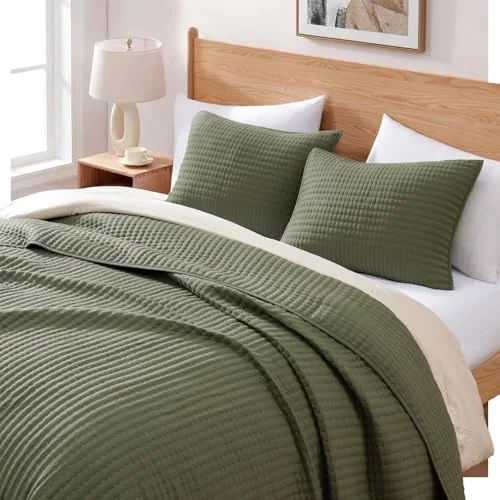
A quilt is not a short comforter. It is cut deliberately longer and narrower, because it is designed to be tucked or layered rather than draped. Our Lightweight Quilt Set runs 90″ × 94″ in Queen and 106″ × 94″ in King. Note the extra length compared to the comforter's 90 inches, and the extra width in King.
That extra four inches of length is what lets a quilt tuck under a pillow bolster and still reach the foot of the bed. If you plan to use a quilt over a comforter as a winter layer, size it the same as the comforter or one up, never down.
Throws: the size nobody measures and everybody argues about
Throws are sold in cuts, not sizes, and the cut decides what the blanket is for:
- 40″ × 40″. The chair square. One person, seated, reading.
- 50″ × 60″. The couch standard. One adult under it, feet covered, on a sofa.
- 50″ × 70″. The long throw. Two people on a sofa, or one tall one.
- 60″ × 80″. Covers a twin bed, or becomes the second layer on a Queen.
- 90″ × 108″. Full King-bed coverage.
Our Checkered Knit Throw spans most of that range, so the same pattern turns up in a nursery and across the foot of a King bed on the same shelf.
How to measure, step by step
Five minutes with a tape settles arguments that browsing cannot. Do it in this order:
- Strip the bed to the mattress. Bedding already on it distorts every number you are about to take.
- Measure the width across the middle. Not at the corners, where quilting and edge tape swell the profile. Write it down; a "Queen" that measures 59 or 61 inches is normal manufacturing tolerance.
- Measure the height at the side, floor-side of the seam. Include the topper if you use one all year. Exclude it if it comes off in June, and accept that summer will drape slightly longer.
- Decide the stopping line. Stand at the foot of the bed and hold a tape down the side. Frame, foundation, or floor: pick one and note the inches.
- Do the arithmetic. Width plus twice the drop. Length matters less, because the head end disappears under pillows and the foot end only needs to clear the mattress.
One caveat worth the sentence: if your bed sits against a wall on one side, you only need drop on one side, and buying for two will leave a pile of fabric trapped between mattress and wall. Bunk beds and daybeds are the common cases.
Sizing for rooms that are not the main bedroom
Guest rooms
A guest room is the one place where sizing up is almost always right. Guests do not know your bed, will not straighten it, and a generous drop hides an unmade morning. Guest beds also tend to be older and shallower than the primary mattress, which means a standard-size comforter drops further than it does in your own room. That is a bonus, not a problem.
The second guest-room rule concerns temperature: you cannot ask a visitor whether they sleep hot. Make the bed with a comforter and leave a folded quilt at the foot. That way the room answers both preferences without anybody having to raise the subject.
Children's rooms and bunk beds
Twin and Twin XL cover almost every child's bed in America, and the difference matters more than the five inches suggests: Twin XL is the dorm standard, Twin is the childhood one. Buying a Twin XL for a Twin bed leaves the comforter trailing on the floor at the foot, exactly where feet land in the morning.
For a bunk, size down on the drop rather than up. A comforter with a 16-inch drop on an upper bunk becomes a curtain that catches on the ladder. Our Twin 2-Piece Set is deliberately minimal for this reason: comforter and sham, nothing to trail.
Dorm rooms
Nearly every American dorm bed is Twin XL, and nearly every incoming freshman buys Twin. The result is a fitted sheet that pops off a corner at 2am for a whole semester. Check the housing paperwork rather than assuming, then buy the Twin XL 5-Piece Set which is cut for it.
Five mistakes that show up in returns
- Buying by mattress name alone. The number this whole guide is about.
- Forgetting the topper. Three inches of memory foam quietly eats six inches of comforter.
- Matching the comforter to the fitted sheet size. Two different calculations that happen to share a word.
- Assuming the sham is a cushion. A sham is a pillow cover cut from the shell fabric. It will feel like a pillowcase, because that is what it is.
- Sizing a quilt down because it is "just a layer". A layer that does not reach is not a layer, it is a lap blanket.
Questions we get by email
Can I use a King comforter on a Queen bed?
Yes, and many people should. It produces a 21-inch drop and the deliberately generous look you see in hotel photography. What it does not do is fit the Queen shams that came with a King set, so mind the sham sizes if you are mixing.
Why is my new comforter shorter than my old one at the same size?
Two likely causes. Either your mattress got deeper since the last purchase, or the previous comforter was cut oversize and this one is cut to nominal. There is no industry standard forcing a "Queen" comforter to be any particular dimension, which is why every item page in this catalogue prints its measurement rather than its size word alone.
Do prewashed sets shrink?
Barely, and that is the point of prewashing: most of the shrinkage happens at the factory before the fabric is cut. What you measure on delivery is close to what you will measure in a year.
How do I stop the comforter sliding off one side?
Usually the bed is not centred on the frame, or the comforter is not centred on the bed. Both are fixable in ten seconds a morning. If it persists, the comforter is too small for the mattress depth and no amount of straightening will hold it.
A five-minute method
If you take one thing from this guide, take the order of operations:
- Measure mattress height, including any topper. Write it down.
- Decide the look: frame, foundation, or floor.
- Add the drop twice to your mattress width. That is your target comforter width.
- Compare against the real measurements above, not against the size word.
- If the target sits between two sizes, go up. A comforter that is slightly too generous reads as luxurious. One that is slightly short reads as a mistake, every single morning.
Everything in the Wrensonge bedding catalogue is listed with its measured dimensions on the item page, not just its size word. Start from Comforter Sets if you are dressing a whole bed, or Quilts & Bedspreads if you are adding a layer to one that already works.
And if the fabric itself is what you are weighing rather than the fit, that is the subject of the next guide in this series.
Sources opened and read on 2026-08-06: OEKO-TEX® — OEKO-TEX® Standard 100; Sleep Foundation — Best Temperature for Sleep; Sleep Foundation — How Often Should You Wash Your Sheets?.